
101: The Circuit Breaker in Chinese Trail Races
Why races get stopped mid-course, how organizers typically respond, and what it means for foreign runners — with three real 2025–2026 cases.
What is a "Circuit Breaker"
"Circuit breaker" — 熔断 (róngduàn) in Chinese — is the term Chinese trail races use for an automatic stoppage, borrowed from the word for a stock market trading halt. When weather or course conditions cross a defined danger threshold, the race must stop.
It's not optional for organizers: a 2024 government notice on high-risk mountain sports events makes it mandatory.
If you've raced in Europe, this might sound familiar — French prefectures can legally order a race cancelled during extreme heat, and it's happened: Trail du Schnepf was banned outright in June 2026 after the organizer refused to call it off voluntarily.

China's version works on the same principle — a government authority, not just the race director, holds the power to stop the race — but casts a wider net, covering any dangerous weather, not just heat. Know this going in, so you're not caught off guard by how fast and how officially a Chinese race can shut down.
What can trigger a circuit breaker?
Based on real cases (below), triggers include:
- Extreme weather forecast before the race starts — strong wind, sudden temperature drop, frost, severe convective storms
- Government risk alerts — provincial disaster-reduction or emergency-management bureaus issuing formal warnings for heavy rain, flash floods, or landslides
- Conditions deteriorating in real time on course — rain already intensifying, trails turning slick, muddy, or prone to landslide and hypothermia risk
Circuit breakers aren't always full cancellations. They can mean cancelling one week's races but not another's, moving the start earlier to dodge a storm, merging or dropping distance categories, delaying a start that hasn't happened yet, or halting a race already underway.
Three Real Examples
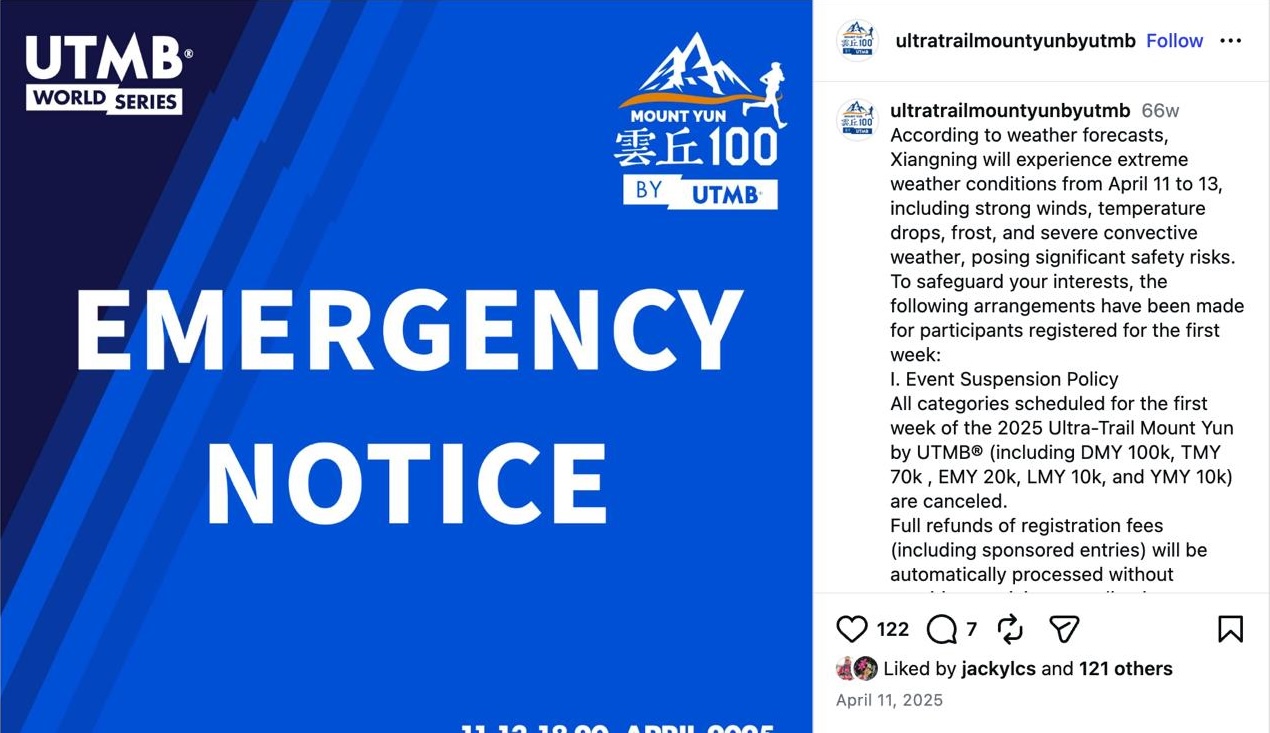
1. Cancelled close to the event — Mount Yun by UTMB (April 11, 2025)
Days before the race, forecasters called for extreme weather around Mount Yun (Yunqiu Shan) in Shanxi province from April 11–13: strong winds, falling temperatures, frost…
The organizer triggered an emergency circuit breaker for the entire first race weekend, cancelling all five groups — 100K, 70K pairs, 20K, 10K women's, 10K youth.
2. Rescheduled at the last minute — CCTF Shennongjia Ultra Race (May 16, 2026)
Two days before the race,, Hubei provincial authorities — the administrative tier directly over Shennongjia — issued a formal risk alert: heavy rain and severe convective weather forecast for May 16–18, with elevated flash-flood and landslide risk in the region.
Rather than cancel outright, organizers moved the whole race earlier, ahead of the storm. The 28K start shifted from Saturday to Friday — a full day early — and the 50K group was scrapped entirely, with runners offered a voluntary downgrade to 28K.
3. Circuit breaker mid-event — Batura Trail Mt. Guanmen 100 (May 23, 2026)
While the 100K was underway, heavy rain began at midnight and intensified by 2:00 AM, with more forecast until 6:00 AM. Trails turned muddy and slick — landslide, slipping, and hypothermia risk — conditions the organizer judged unsafe for a high-intensity 100K.
The circuit breaker triggered immediately: the 100K was terminated at 3:30 AM. The 60K, which hadn't started yet, had its start delayed pending better trail conditions — and was ultimately downgraded to 30K with a new start time.
How organizers typically respond and compensate
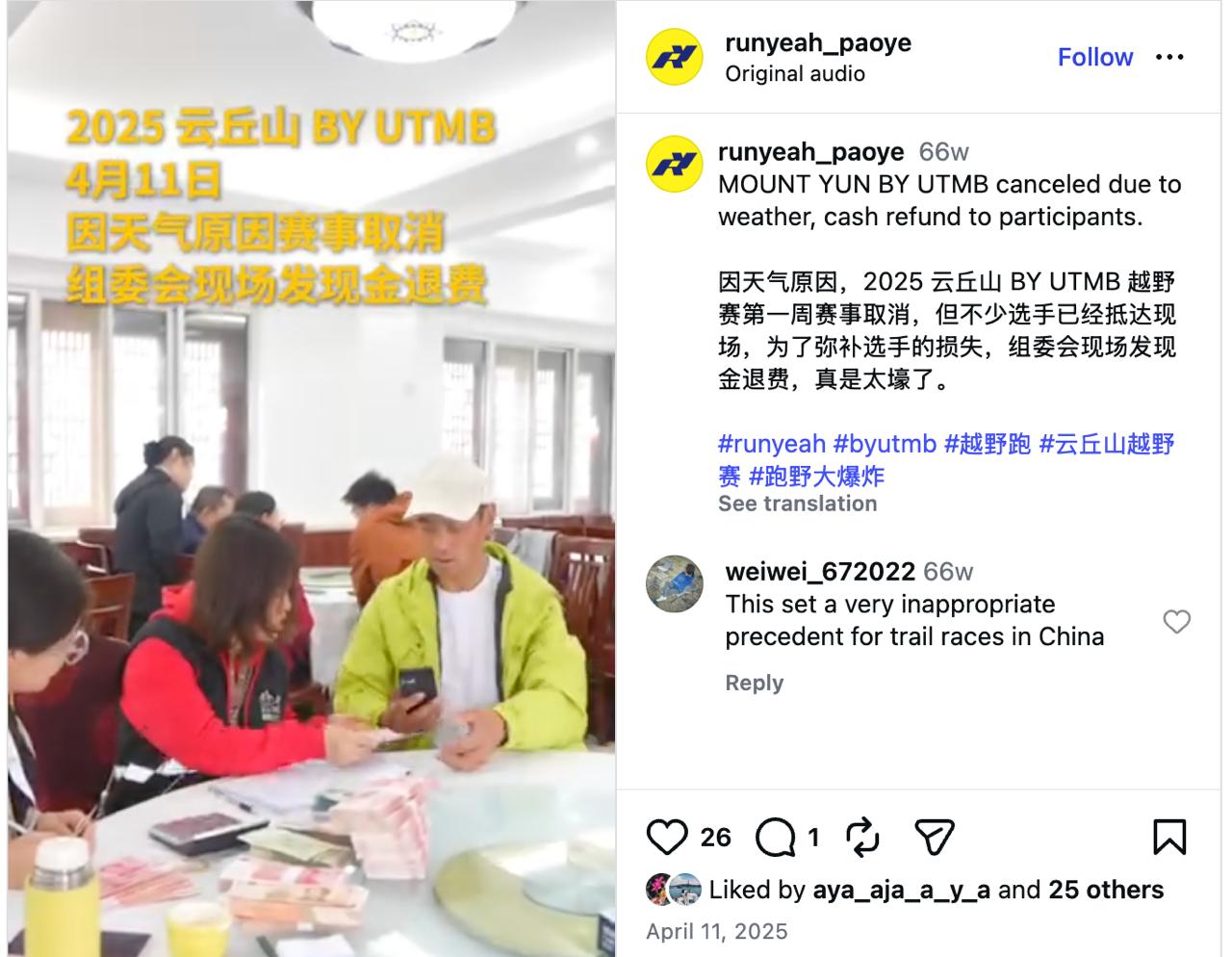
Across all three cases, communication ran almost entirely through the official WeChat account, sometimes backed by text messages (短信) to registered phone numbers. On-site signage and staff announcements matter too, especially mid-race.
As for compensation, organizer response varies, but a few patterns hold:
- A full refund of the entry fee is standard — organizers consistently return what they collected from runners.
- Compensation for travel and lodging isn't guaranteed — it depends. Only the pre-event cancellation (Mount Yun) reimbursed transportation and hotel costs, likely because runners had enough lead time to document expenses and hadn't yet used up most of the race weekend.
- "Defer to next year" is a common alternative to a refund, especially in reschedule scenarios (Shennongjia) — useful if you've already made a large non-refundable trip investment and don't want to walk away empty-handed.
Advice for foreign runners
-
💡 Follow the race's official channel (where you signed up) before you travel, and keep notifications on. This is where circuit breaker announcements land first — often hours, sometimes a full day, before you'd hear about it any other way.
-
💡 If a circuit breaker fires while you're on course, follow staff and course marshal instructions immediately — don't wait for an English translation, and don't push on to the next checkpoint on your own judgment. The rule exists because conditions can deteriorate faster than word can reach you.
-
💡 Pair your race with other travel plans in China. This one maybe the best advice, if your trip still has plenty to offer beyond race day, a circuit breaker won't wreck the whole visit — just one part of it.